
Agia Paraskevi
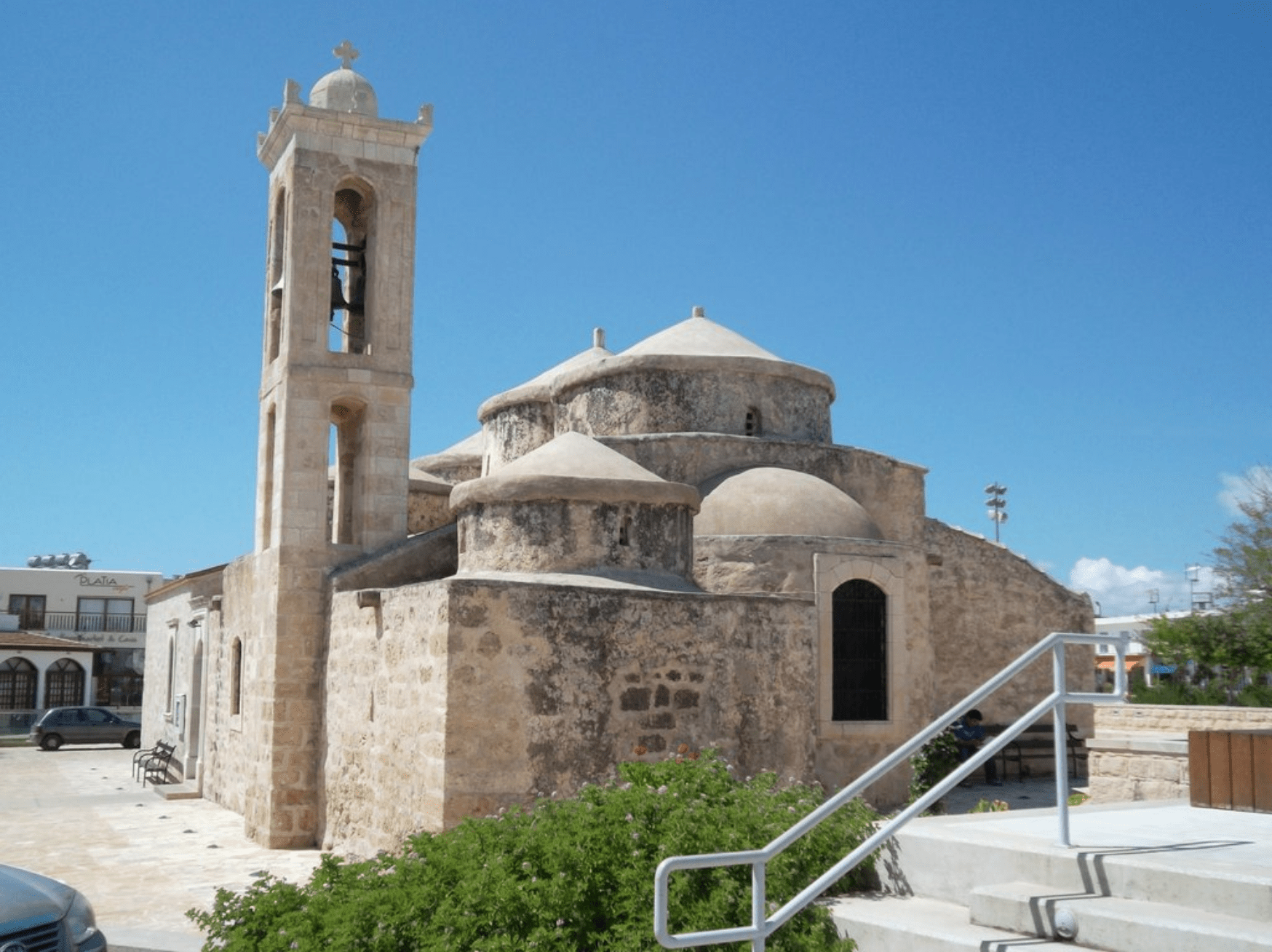
The church of Agia Paraskevi is located in the village of Geroskipou, 3.5 kilometres east of Paphos. It is an exceptionally important example of Byzantine architecture, dating to the 9th century. It has not been established whether this church was built on the remains of an ancient temple of Aphrodite. According to tradition, Geroskipou took its name from the sacred gardens of the goddess, which lay to the south of the village towards the sea, at the point where pilgrims set out for the sanctuary of Palaepaphos. It is likely that the church was originally dedicated to the Holy Cross. Today, however, it is dedicated to the Christian martyr Agia Paraskevi.
The architectural type of the church belongs to the category of the three-aisled vaulted basilica with five domes. The three larger domes stand over the central aisle and the two smaller ones in the middle of the side aisles, to the north and south of the central dome of the middle aisle. Externally the church resembles the church of Saints Barnabas and Hilarion at Peristerona, while it shares certain features with the churches of Apostolos Varnavas near Salamis and Agios Lazaros in Larnaca.
Attached to the south-eastern corner of the church is a small tetraconch covered by a small dome. Tetraconchs were widespread during the early Christian period and served either as martyria or as baptisteries. The western wall of the church was demolished in order to extend it, probably in the 19th century. The original entrances of the church must have been located in the western wall.
The interior of the church of Agia Paraskevi is decorated with wall paintings dating to various periods, from the 8th-9th, 10th and 12th up to the 15th century. During cleaning and conservation work carried out on the surviving wall paintings of the church by the Department of Antiquities between 1974 and 1977, an early-type monochrome reddish cross, painted directly onto the stone, was revealed on the northern side of the wall of the north arcade. The cross has arms ending in trefoil terminals. Such crosses are found during the early Christian period, up to the 8th-9th century.
Above the Sanctuary and the Holy Altar, in the eastern dome of the middle aisle, an aniconic composition is preserved, with a jewelled cross as its central theme, framed by three decorative bands with geometric motifs. The cross, which is the only aniconic composition known in Cyprus to this day, is located at the centre of the dome and preserves only the ends of its arms. The cross was the pre-eminent symbol depicted during the period of Iconoclasm, and thus the year 843 constitutes the terminus ante quem for the construction of the church. It should be noted, however, that aniconic wall paintings continued to adorn provincial churches up to the 12th century.
The next phase of wall paintings dates to the 10th century and was revealed beneath the later phase of the 15th century. The wall painting of the Dormition of the Virgin, located in the tympanum of the northern blind arch, dates to the 12th century, as do the remains of the Platytera among archangels, preserved in the conch of the apse. The surviving 12th-century wall paintings were also found beneath the later 15th-century layer. The final phase of the church’s decoration is dated to the 15th century. These wall paintings are located in the central dome of the middle aisle.
In addition to the wall paintings, the church of Agia Paraskevi also preserves a notable double-sided icon of the 15th century. On one side the Virgin is depicted in the Hodegetria type, in which the anonymous painter follows Palaeologan models, while on the other the Crucifixion is depicted, with models influenced by Western painting.
District Paphos
Telephone —
Opening hours 8.00-13.00, 14.00-16.00 (winter hours), 8.00-13.00, 14.00-17.00 (summer hours)
Admission fee Free
Opening hours
-
Monday8:00 am - 4:00 pm
-
Tuesday8:00 am - 4:00 pm
-
Wednesday8:00 am - 4:00 pm
-
Thursday8:00 am - 4:00 pm
-
Friday8:00 am - 4:00 pm
-
Saturday8:00 am - 4:00 pm
-
Sunday8:00 am - 4:00 pm