
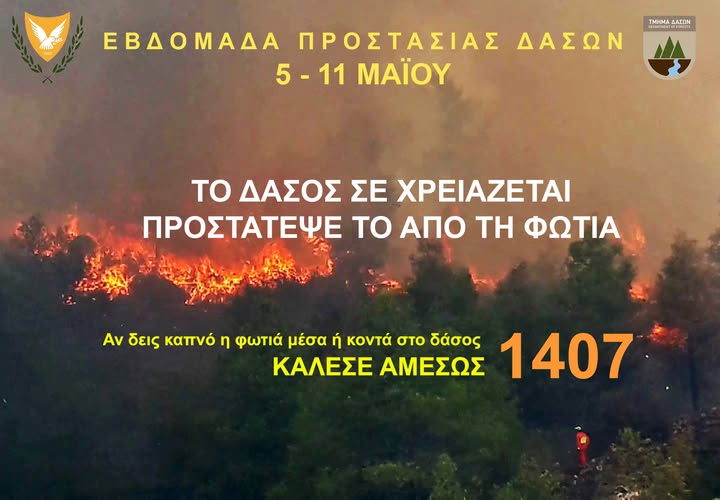
FOREST PROTECTION WEEK 5 – 11 May 2025
The Forests of Cyprus
The forests of Cyprus form the backbone of our natural environment. They are the priceless, enduring and renewable Natural Resource of our country, passed down from generation to generation, which is why efforts to expand and strengthen their protection remain a constant and permanent concern of the competent authorities. Through their wide-ranging and lasting contribution, forests play an essential role in human economic and social development, in improving quality of life, and in physical and mental health, while at the same time helping to maintain ecological stability.
As the competent authority, the Department of Forests aims to keep Cyprus’s forests in the best possible condition and to achieve the maximum environmental, social and economic benefit, based on the principle of sustainability. Through various actions and initiatives, we seek, on the one hand, to highlight both the environmental value of the forest and its enduring, direct connection to people, and on the other hand, to raise public awareness on matters of forest and environmental protection and, more generally, on forest fires. The Department of Forests takes all the necessary measures to protect our forests, especially from fire. These measures relate to the prevention, detection and reporting of forest fires, and their suppression.
Forest fires and their consequences
Fires are the most serious threat to the existence of Cyprus’s forests. Most of them (9 out of 10) are caused by human activity. High and extreme temperatures, strong winds, the drought-resistant nature of the vegetation and the steep slopes of forested land are some of the factors that favour large forest fires. In recent years in particular, owing to the abandonment of the countryside and, by extension, the abandonment of farming and livestock rearing, as well as the prolonged lack of rainfall and drought brought about by the climate crisis, communities bordering the forests face immediate danger when a fire breaks out. Another factor that significantly aids the spread of a fire is the accumulation of large volumes of flammable fuel material on uncultivated and abandoned land.
Forest fires cause ecological devastation with short-term, medium-term and long-term consequences. These consequences may be environmental, material, social, cultural and economic. The main consequences of fires are the loss of human lives and property, the destruction of the natural environment, the loss of habitat for wildlife and flora, soil erosion, the creation of torrential and flood phenomena, and the reduction of drinking water reserves.
Climate change, or the climate crisis
Another significant factor with an adverse impact is the continually worsening climate change, or rather the climate crisis as it is now called, which is unfolding on a global scale. According to confirmed estimates by scientists, the past year was the hottest in the last 174 years. Scientists are constantly sounding the alarm, reminding us of the lack of unified and active effort to address the climate crisis. The countries of the southern hemisphere are hit hardest by climate change, experiencing extreme weather phenomena, extreme temperatures, irregular rainfall, floods and disasters, long periods of drought and other phenomena. Cyprus is among these countries, as are most of the countries bordering the Mediterranean Sea. In recent years these countries have been plagued by forest fires of enormous scale which, in their path, literally reduce to ashes hundreds of thousands of acres of forest, accompanied by immense damage to private property and, worst of all, causing loss of human life. A characteristic example is the fires in Greece, Spain, Portugal, France, Croatia and elsewhere over the past year.
The World Meteorological Organization (WMO) confirmed that 2024 was the warmest year on record, based on six international datasets. The last ten years also saw record-breaking temperatures.
The global mean surface temperature was 1.55 °C (with an uncertainty margin of ±0.13 °C) above the 1850-1900 average, according to the WMO’s consolidated analysis of the six datasets. This means that we have most likely just experienced the first calendar year with an average global temperature more than 1.5 °C above the 1850-1900 average.
The causes of fires in Cyprus
The main causes of forest fires in Cyprus, based on data kept by the Department of Forests, are agricultural activities, the burning of rubbish, the use of tools that produce sparks, the careless discarding of lit matches or cigarette ends, the lighting of fires by excursionists to prepare food outside approved areas (picnic and camping sites), military activities, various activities at holiday homes, short-circuiting of electrical cables and, more rarely, lightning strikes.
Measures taken by the Department of Forests
The Department of Forests applies an integrated forest fire management system built around three main pillars: prevention, detection and suppression of forest fires. This system is continually improved and upgraded in line with emerging needs and technological developments. The Department of Forests has been, and continues to be, reinforced both in human resources and in equipment, such as fire engines, bulldozers, agricultural tractors, platforms for transporting heavy vehicles, and technological means such as drones. The cornerstone of the entire system is the Department’s personnel, Forestry Officers and Firefighters, who respond daily, defying every danger and battling the flames.
The contribution of the public
We must all realise that forests are not the responsibility of the Department of Forests alone; each of us has a role to play, and we have a responsibility and an obligation to safeguard our forests as the apple of our eye. Forests are our priceless heritage. It is our duty and obligation to hand them over intact to the next generations, just as we borrowed them from our ancestors, so that they too may enjoy and delight in them. It is precisely for this reason that everyone’s cooperation with the competent authorities is considered essential in order to achieve this objective. In particular, we must be careful about our behaviour both when we are in the forest and in our everyday activities. It is imperative that we avoid, and also prevent, any action that could potentially cause a fire. If we spot smoke or fire, in or near the forest, we should call 1407 immediately (the forest fire reporting line – free of charge) or 112.
Forest Protection Week
With the aim of reminding, raising awareness and encouraging more meaningful participation by citizens, especially the young, in the efforts made to protect forests, the Department of Forests has established and organises “Forest Protection Week” every year. This year the week has been set for the period 5 to 11 May.
This year’s fire season is expected to be more difficult than last year’s, since the adverse weather conditions of the winter period, with reduced rainfall and prolonged periods of drought, rising temperatures and scientists’ predictions that the earth has entered a phase in which temperatures are continually rising, combined with the factors that contribute to the outbreak and spread of forest fires, mean that this summer is expected to be particularly dry. The Department of Forests declares its readiness to join the battle against forest fires, better organised than in recent years. It is, however, CERTAIN that this alone cannot fully and entirely achieve the major goal of protecting our forests from fire. Cooperation and mutual assistance with all the Services involved in forest firefighting is an imperative and given necessity. The contribution and conduct of each of us, however, is important. We must therefore be especially careful in our activities in the countryside, and particularly at holiday homes, avoiding entirely the use of fire or tools such as welding equipment and angle grinders that produce sparks. In addition, we must take all appropriate preventive measures around our holiday homes, barbecues, ovens, and any pumping stations and electric turbines we may have, since even the smallest spark can cause a major fire. Where it is necessary to use such tools by assigning work to third parties, this must be done only under our own supervision and guidance, so as to prevent the risk of a fire breaking out.
Our own responsibility
We must all understand the importance of forests to humankind and become vigilant guardians of their protection. Especially today, more than ever before, forests are essential for both our health and our quality of life. Every inch of forest that burns, combined with the climate change under way, particularly in the Mediterranean region, could gradually lead our island towards desertification. Let us therefore stand together, all of us, as a barrier against the shrinking of our forests and our natural environment. Protecting the forest from fire is the responsibility and duty of us all.